Warehouse Processes End to End: Inbound to Outbound
A walk through all 14 steps a shipment goes through between the gate and the gate again, from the person who has run warehouses for 25 years.
The Warehouse Processes Poster is available for Download at the end of this blog.
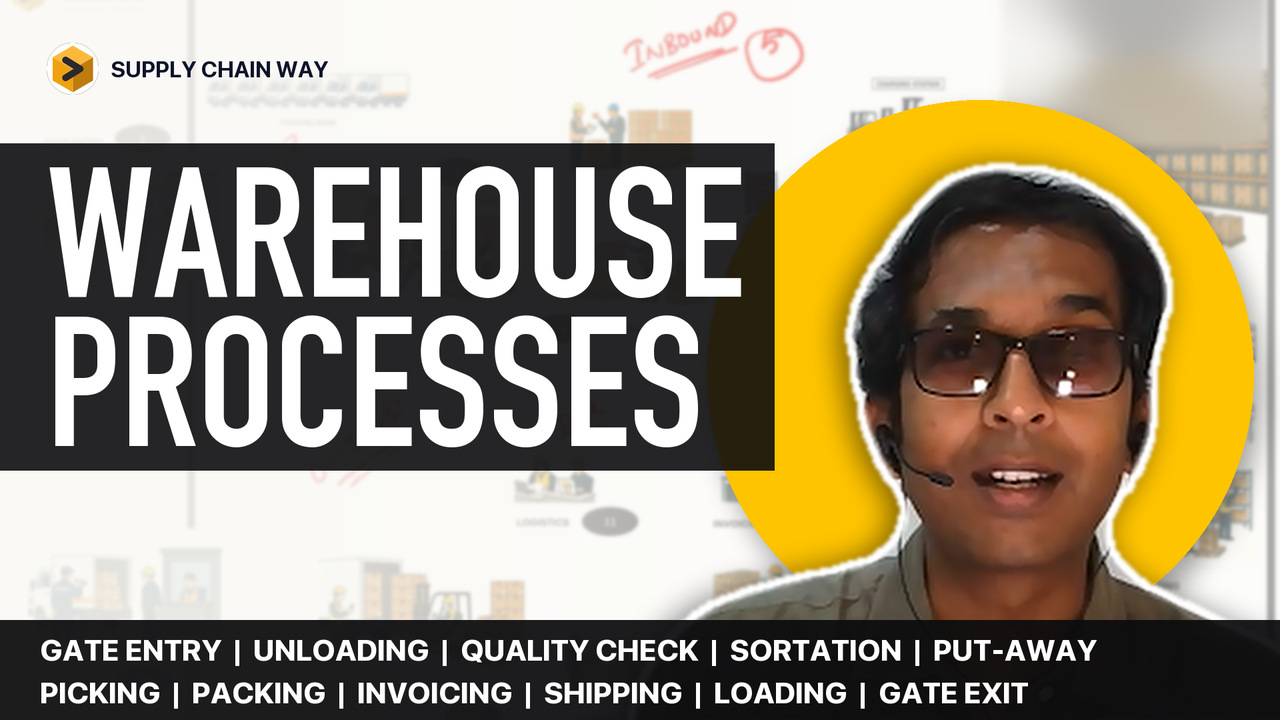
A warehouse looks complicated from the outside: forklifts, racking, barcode scanners, people moving boxes in every direction. Strip away the equipment and the software, and it comes down to four walls with two doors. Goods come in one door. Goods go out the other. Everything in between, 14 processes in total, exists to get a shipment from the inbound gate to the outbound gate without losing it, damaging it, or sending the wrong thing to the wrong customer.
Those 14 processes split cleanly into two halves. Inbound covers the first five: gate entry, unloading, quality check, sortation and put-away. Outbound covers the remaining nine: order processing, picking, packing, a second quality check, invoicing, logistics booking, shipping, loading and gate exit. Here is what actually happens at each one.
Inbound: Getting Stock Into the Warehouse
1. Gate Entry
Nothing enters a warehouse on trust. At the gate, security checks the vehicle against three documents: the purchase order, the packing list and the required-by date. The purchase order confirms this delivery was actually ordered. The packing list confirms what the driver says is on the truck matches what is supposed to be on it. The required-by date matters because a supplier who shows up without warning, outside an agreed window, disrupts a dock schedule that was planned around other trucks.
Parking and dock allocation
Trucks that clear the gate do not drive straight to a dock. They wait in a parking zone until a dock is free, the same way a doctor’s clinic works. Everyone has an appointment, but you still sit in the waiting room until the doctor is actually free to see you. A warehouse with ten docks and thirty trucks arriving in the same hour would seize up without that buffer.
2. Unloading
Once a truck is allocated a dock, the unloading team counts what comes off it against the packing slip, not against the purchase order. The packing slip is what the supplier is physically handing over right now. Quantities get reconciled here before anything moves further into the building.
Short shipments and proof of delivery
When the count does not match the packing slip, that is a short shipment, and it gets logged immediately, not discovered three weeks later when a stock count comes up short. The signed proof of delivery, the POD, is the warehouse’s evidence of exactly what was received and when. It is the document that protects the business in any dispute with the supplier or the transporter.
3. Quality Check
Incoming stock is checked either by sampling a portion of the batch or by inspecting every single unit, depending on the product, the supplier’s track record and the risk of a defect. This is also where Direct to Storage, or D2S, suppliers come in. A D2S supplier has earned enough trust over time that their goods skip the full quality check and go straight to storage. It is a status a supplier has to earn, not a default.
Pass or fail: the Red Tag process
Stock that fails quality check gets a red tag. That is not a label, it is a hold. Red-tagged stock cannot move to storage, cannot be picked and cannot be shipped until someone resolves it, whether that means a supplier claim, a rework, or a write-off. The tag exists precisely so a bad batch cannot quietly slip into available inventory.
4. Sortation
Stock is sorted before it goes to put-away, not after, because sorting first means goods headed to the same zone or the same storage type move together instead of crossing the warehouse floor twice. Skip this step and put-away slows down for every single pallet, not just the ones that needed sorting.
5. Put-Away
This is where stock actually reaches its storage location, using a reach truck, a forklift, a hand pallet truck or a bin cart depending on the weight, the height and the storage type. Only once put-away is complete, and the system is updated to reflect it, does that stock become available for sale. A pallet sitting on the dock is not sellable inventory yet, no matter how long it has been in the building.
That is inbound. Five processes, one job: get stock in, verified, and shelved as inventory the business can actually sell.
Outbound: Getting Stock Out to the Customer
6. Order Processing
An order starts as a request, from a store, a distributor or a direct customer, and gets converted into a pick list: the exact items, quantities and locations a warehouse worker needs to go and retrieve. A clean pick list is what makes everything downstream fast. A messy one is what makes picking slow.
7. Picking
Workers follow the pick list through the warehouse, pulling stock from its storage location. For taller racking, this is where the order picker comes in, a piece of equipment built specifically to lift a person safely to pick height rather than having them climb racking or use a standard forklift for a job it was not designed for.
8 and 9. Packing and Quality Check
Picked items get packed for shipment, and for e-commerce in particular this step carries real weight: the box a customer receives is the brand’s only physical touchpoint with them. A second quality check, the outbound QC, happens here too, catching anything that went wrong between storage and the packed box before it ever reaches a customer.
10. Invoicing
The invoice is generated once the order is packed and confirmed, not before. Invoicing against a packed, verified order rather than a planned one is what keeps billing accurate.
11. Logistics Booking
Transport gets booked for the shipment, matching the order to a carrier, a route and a vehicle. This is where the handoff from warehouse operations to transportation starts to take shape.
12. Shipping
Packed orders move to a ready-to-ship location, staged and waiting for the vehicle that logistics booking arranged. This staging area is what keeps loading fast: nobody is hunting across the warehouse for an order while a truck sits at the dock.
13. Loading
Orders are loaded onto the outbound vehicle, closed out with a final scan that confirms exactly what left the building. That scan is the outbound equivalent of the packing-slip count at unloading: the warehouse’s own record of what actually went out the door.
14. Gate Exit
The outbound vehicle passes a final security check before it leaves the premises, the same gate discipline applied on the way out that was applied on the way in. The shipment’s journey through the four walls ends here.
Warehouse Management System vs Transportation Management System
Everything above, inbound and outbound, inside the four walls, is the job of a Warehouse Management System, a WMS. The moment a shipment leaves the gate and becomes a question of routes, carriers and delivery schedules, that is a Transportation Management System, a TMS. Knowing exactly where a WMS’s job ends and a TMS’s job begins is one of the more common gaps in how people new to the field describe their own operations, and it is worth being precise about.
Why This Matters
If you are trying to break into warehousing operations, design a warehouse layout, prepare for a warehousing interview or move into supply chain from another function, these 14 processes are the baseline. Not the automation, not the software, the sequence itself. Every system you will ever work with, however advanced, is automating some version of these exact 14 steps.