
Understanding Warehouses: Key Functions and Benefits
What Is a Warehouse?
Hello everyone. In this post, we’re going to learn what a warehouse is. Let’s get started.
A Simple Story to Explain It
I’m going to tell you a small story and, using that story, explain what a warehouse is.
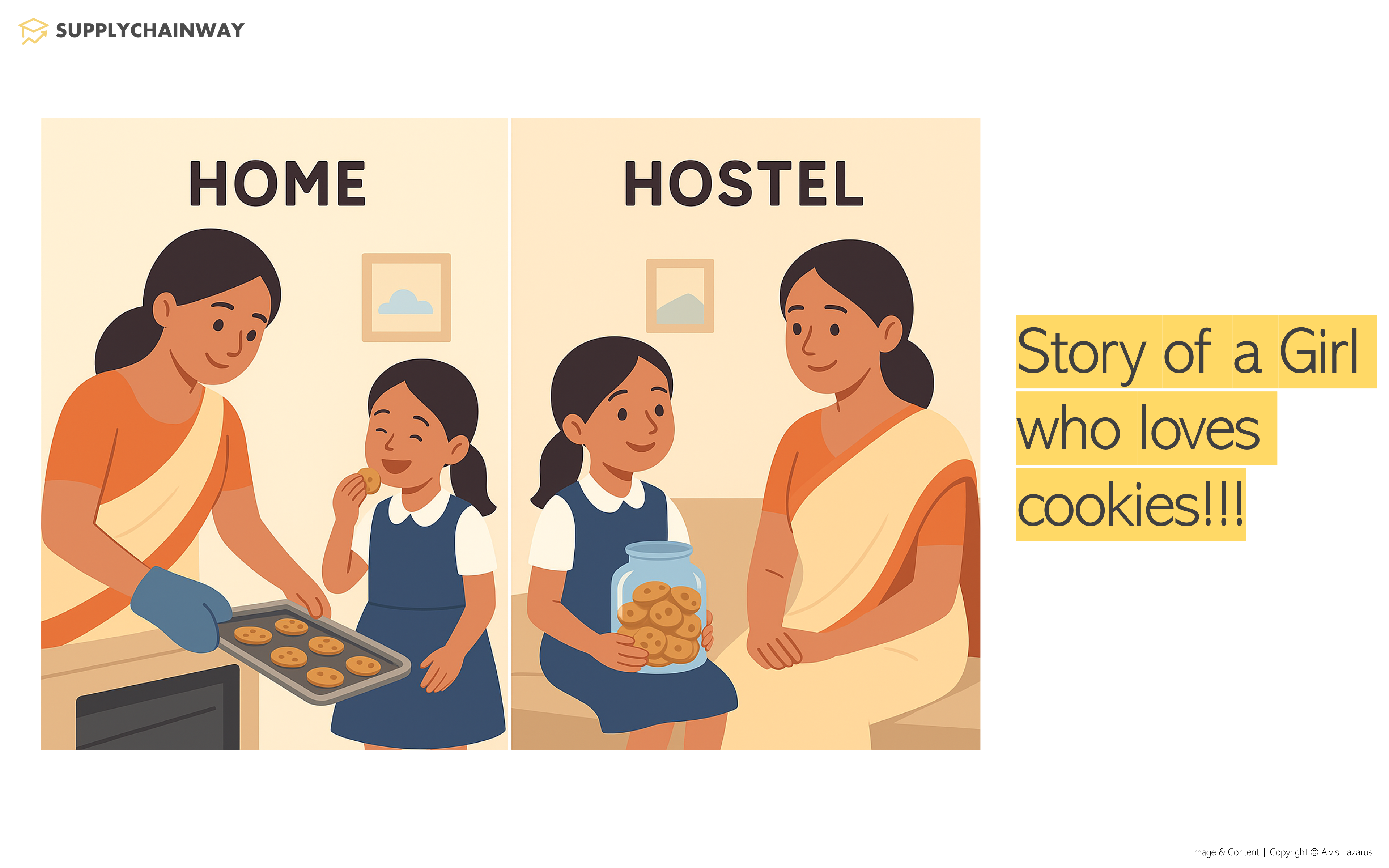 It’s about a girl who loves cookies. As you can see from the image in my video, the girl is at her home; her mom has baked fresh cookies and she’s enjoying them.
But what happened? For some reason, she has to join a different school that’s not in her native place. She has to leave her family and stay in a hostel.
Now, she can’t stop eating cookies, and her mom doesn’t allow her to buy cookies from outside. So every week, her mom visits her at the hostel and carries cookies for her.
Here’s the catch: when she’s at home, there’s no need to store anything—cookies are freshly baked and eaten. But in the hostel, where mom can visit only once a week, there is a requirement to store those cookies so the girl can have them when required.
So what happens? In the hostel, the mom gets her a cookie jar that can store cookies for at least a week—keeping them fresh, not letting them go bad, and ready to eat.
The Cookie Jar = The Warehouse
The role of the cookie jar here is to store the cookies. And why store them? Because mom cannot visit every day with freshly baked cookies. That puts us in a situation where storage is required, and that storage is taken care of by the cookie jar.
In a sense, that cookie jar is nothing but a warehouse.
In a business scenario, the sole purpose of the warehouse is to store products in a safe and nice condition.
A Quick Definition
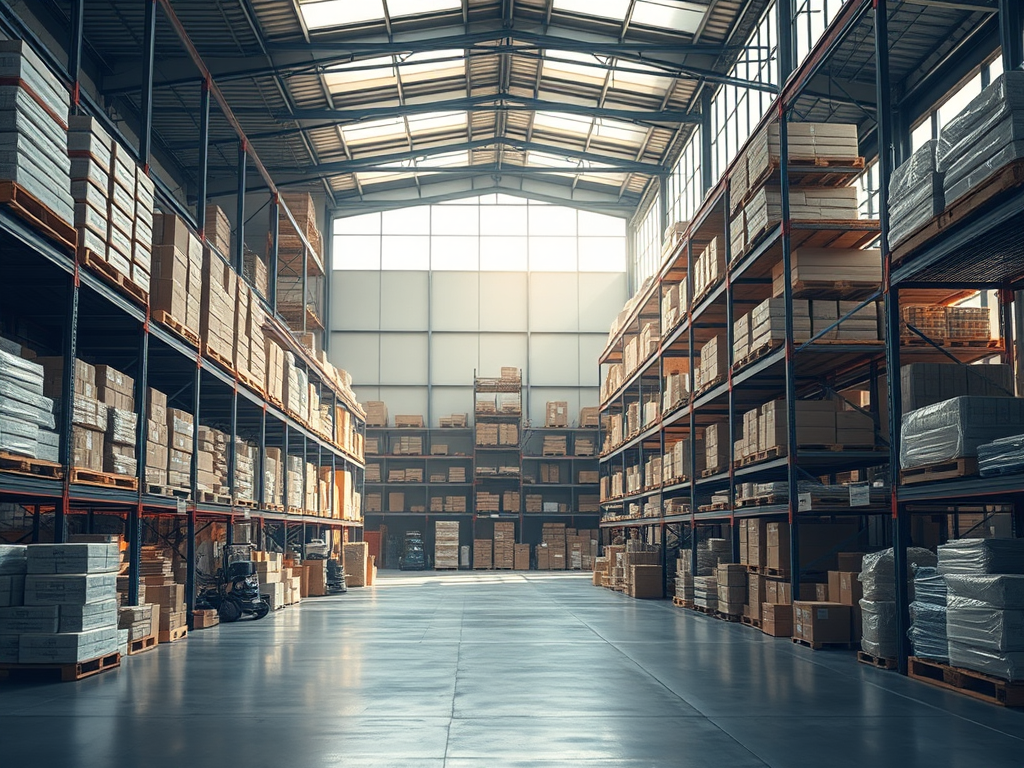
A warehouse is a large building or facility used for storing goods. That’s it.
And those goods can be:
- Raw materials (not yet converted into finished goods)
- Semi‑finished goods
- Finished goods
At any stage of a product’s conversion, if there’s a requirement to store it, you need a warehouse to store it.
The Primary Purpose (Bridge Between Production and Consumption)
As I told you, the primary purpose of a warehouse is to store the product. In addition, it also acts as a bridge between production and consumption.
Let’s step back and look at that cookie‑jar situation again:
- The jar has to ensure the cookies are fresh, right?
- The jar should hold enough cookies for one week of the girl’s consumption.
So the jar is ensuring she is able to have cookies at the right time and in the right quantity—and in the right condition.
That’s exactly the purpose of a warehouse in business: to ensure goods are available at the right time, in the right quantity, and in good condition.
Okay. I’m sure now you won’t forget the role of the warehouse, and you don’t need to memorize it—just remember the cookie jar.
Other Purposes of a Warehouse
We’ve already covered the first one—storage of goods. Now, some additional purposes:
- Storage of goods
This is the core. Clear and crucial. - Maintaining supply–demand balance
If the cookie jar doesn’t hold enough cookies for the week, what happens? Maybe on Friday morning she runs out, and mom only arrives on Saturday. That’s a sad day for a girl who loves cookies. Similarly, one core purpose of a warehouse is to balance supply and demand. (In a later video in this series, I’ll also talk about how we do this balance.) - Ensuring business continuity (buffer)
A warehouse acts as a buffer so that business doesn’t stop when supply from factories is delayed. Right? - Facilitating distribution
This applies more directly to a distribution center (I’ll talk about types of warehouses in the next video). The idea is that the facility supports efficient distribution to downstream locations/customers. - Value‑added services (VAS)
I told you a warehouse is purely for storage—yes. But today, warehouses also take care of some value‑added services in addition to storage. - Reducing transportation costs
Think of this situation: the production facility is in the northern part of the country, and customers are in the southern part. Rather than shipping individual units to different customers, you can keep a warehouse in the south. Move products in bulk from north to south based on requirement, and then distribute from the southern warehouse to customers. This saves a lot of transportation cost.
The One Line You Should Remember
All these points describe the purpose of a warehouse. But keep in mind: the sole purpose is storage of products in the right condition without any dip in quality. That’s the essence.
What’s Next
That’s it for this topic. In the next video, I’ll talk about the different types of warehouses. Stay connected. See you soon. Thank you.
Author’s Profile: https://www.linkedin.com/in/alvislazarusa/