
5 Career Mistakes to Avoid If You Want to Become a VP of Supply Chain
Hello everyone,
In this blog, I’m going to cover five critical career mistakes. This is specifically for those of you who have the ambition to become a Vice President of Supply Chain.
So with that, let’s get started.
Mistake #1: Staying Too Tactical
This happens when you get stuck in day-to-day operational problems. You may be really good at it—and this is very much needed. Problem-solving, working with teams, and driving them toward a common goal are excellent managerial skills.
But these skills alone will only help you up to a certain level, maybe as a manager or senior manager. If you want to go beyond and become the top leader in supply chain—the VP—you need to understand the big picture.
One of the biggest challenges in supply chain leadership is that without seeing the bigger picture, you cannot build for the future. And if you can’t build for the future, your career growth will eventually stall.
So yes, continue doing a great job with operations, but also step back and ask yourself: What is the bigger picture? Apart from firefighting, develop the skill of building for the future.
Mistake #2: No Cross-Functional Influence
This one is very important. Supply chain is not just about your own team. It involves customer service, procurement, quality, warehousing, transportation, and more.
If you’re only good within your own function but never make the effort to work with other functions, this will become a bottleneck—and may even kill your dream of becoming a VP.
Here’s the key: when someone directly reports to you, it’s easy to align goals and work as a team. But when it comes to people who do not report to you, how do you still bring them together toward a common objective?
That ability is what defines true leadership in supply chain.
Mistake #3: Avoiding Technology and Data
Avoiding technology is another major mistake. It’s not about becoming a tech expert overnight, but consciously moving in that direction.
Yes, your organization may still rely on spreadsheets and manual processes. That’s fine. But you should understand what’s happening in the technology landscape and gradually adopt tools that make things better.
Start small—robotic process automation, ERP systems, or transportation management tools. As you grow, explore advanced technologies like AI, machine learning, and IoT.
The point is: stay connected with technology and get as hands-on as possible. Just like you are on the operations side, bring that same mindset toward tech and data.
Mistake #4: Holding the Baton Too Long
One of the most common mistakes managers make is not letting go. You’re so good at your job that you become possessive about it. But if you don’t let go, two things happen:
- You can’t develop talent within your team.
- You can’t move into true leadership because you’re stuck in execution.
Remember, as you climb the ladder, execution decreases, and strategy increases. If you continue holding the baton, you’re blocking your own growth and slowing down your team’s.
A great leader builds others to perform just as well (or better) than themselves.
Mistake #5: Playing the Game Without Knowing the Score (Ignoring Finance & Business Acumen)
This is a mistake I personally faced in my own career until my mentor pointed it out. Many supply chain professionals are great at execution but fail to understand how their work impacts the organization financially.
If you can’t answer how your project or decision impacts the P&L, then you’re limiting your growth. Start today.
- Learn the basics of contracts and P&L.
- Don’t shy away from financial discussions—grab opportunities to work with your CFO or finance team.
- Whenever your team completes a project, go to your finance colleagues and ask: What’s the impact of this on the P&L?
This simple step will build your business acumen. Slowly and steadily, you’ll understand how every project ties into financial performance—and that’s exactly what senior leadership expects.
Final Thoughts & Checklist
At the end of this journey, I want to leave you with a quick checklist.
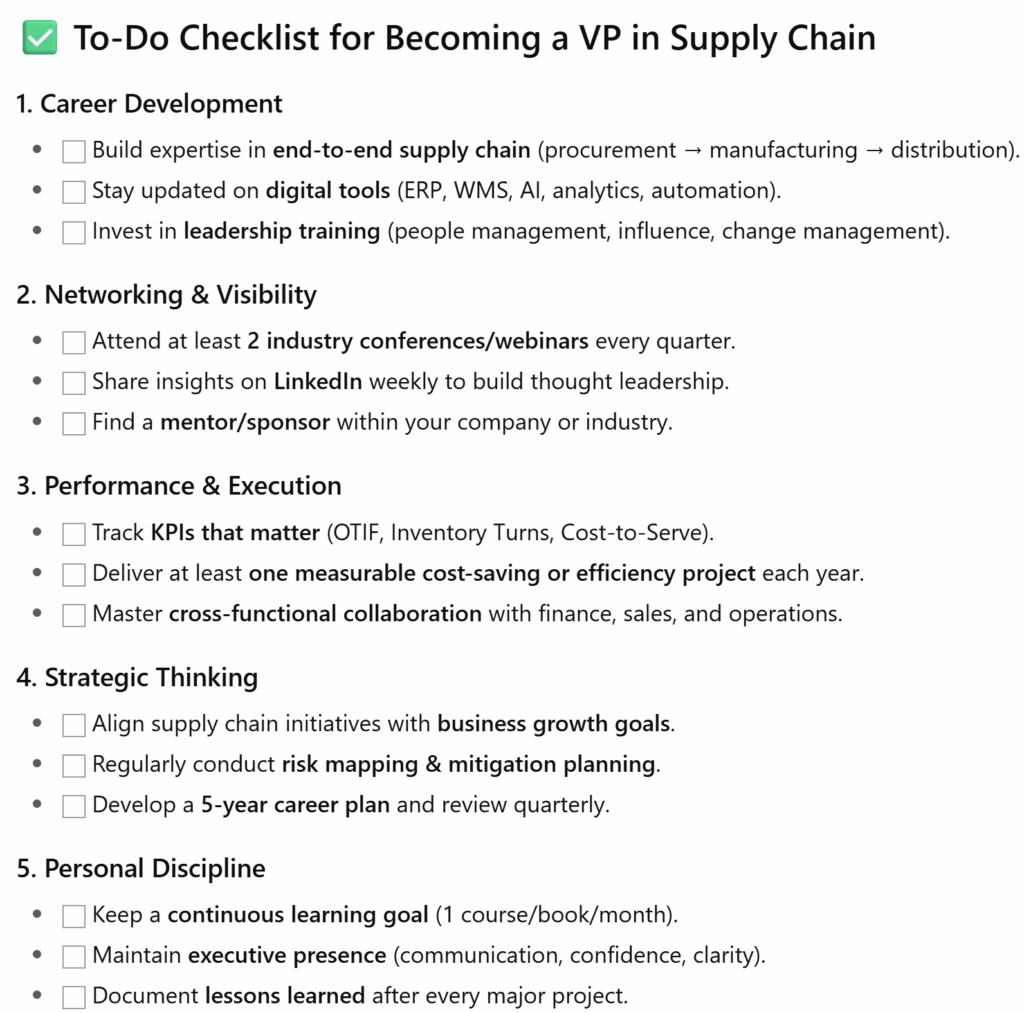
I’ve created 15 pointers across five areas:
- Career Development
- Networking
- Performance & Evaluation
- Strategic Thinking
- Personal Discipline
Take a snapshot, print it, and keep it at your desk. If you can confidently check off each of these, you can be sure you’re heading in the right direction to become a VP of Supply Chain.
I wish you all the very best in your journey.